
White Paper: Managed Contempt, The Bill-Paying Class, the Asset-Growing Class, and the Politics of Telling John Q. Public to Pay Up
Selfish people take as much as they can, and leave you with scraps. Then they told you to budget better. F that. I wrote a white paper to show how the wealthy keep getting richer off others’ pain.

Hello Party People!
Hope you’re safe and still a bit hopeful. Yesterday’s post drew a lot of attention. So today, I bring you a follow-up to “The Hoarders Hoarded.”

I hope you enjoy, maybe get a little mad, and want to get even. 🤭✌️
❤️🫡🇺🇸 sunny
Managed Contempt, The Bill-Paying Class, the Asset-Growing Class, and the Politics of Telling John Q. Public to Pay Up
Working title: F U Pay Me, John Q. Public
Executive Summary
This paper is about the quiet message American politics keeps sending to regular people:
Pay more.
Expect less.
Be grateful.
Blame yourself.
That message is not announced openly. It arrives dressed up as fiscal responsibility, efficiency, national security, tax reform, market discipline, deregulation, deficit concern, and personal responsibility. But the practical effect is the same: ordinary households absorb the costs while the ownership class keeps the gains.
That is managed contempt.
This is the follow-up to the “hoarders hoarded” argument. Extreme wealth does not merely sit in private accounts. It buys access, delay, protection, policy, narrative control, and public patience. The hoard is not passive. It organizes the world around itself.
The central division in the American economy is not simply rich versus poor. It is the bill-paying economy versus the asset-growing economy. Most Americans live in the bill-paying economy. Money comes in through wages, salaries, benefits, tips, Social Security, disability, small-business income, or gig work. Then it leaves: rent, groceries, utilities, insurance, medicine, education, childcare, car repairs, credit cards, debt, and emergencies.
The top 10%, and especially the top 1% and 0.1%, live disproportionately in the asset-growing economy. Their wealth compounds through stocks, real estate, business ownership, private equity, capital gains, tax preferences, inheritance, and asset management. They are not merely surviving the system. They are positioned to profit from it.
The 2024 election was not just a partisan contest. It was a trust collapse. Democratic voters were told the economy was strong while their lived economy said otherwise. They were told democracy was at stake by institutions that often felt closed, donor-managed, consultant-driven, and unwilling to level with people about leadership, succession, affordability, war, class, and power.
Trump exploited that collapse. He promised relief, revenge, lower prices, strength, and a fight against elites. But his second-term policy structure has generally done the opposite for ordinary households: tariffs raised consumer prices, DOGE weakened public capacity, benefit cuts increased private hardship, labor enforcement shifted power toward employers, and tax policy favored those already positioned to gain from assets. And let’s not forget the wave of first quarter 2026 investor reports where multiple CEOs stated AI will replace pesky employees.
This does not mean both parties are the same. They are not. Republicans have more openly advanced upward redistribution through tax cuts, deregulation, labor weakening, tariffs, benefit cuts, and privatization. Democrats have defended important public programs and passed meaningful relief. But both parties operate inside a political economy that repeatedly underserves ordinary citizens outside the top 1–10%.
The result is not simply inequality. It is managed contempt. Regular people are treated as smart enough to work, pay taxes, vote, serve, borrow, obey, and absorb inflation — but not important enough to be told the truth about where the money goes.
John Q. Public gets the lecture. The ownership class gets the return.
I. The Bill-Paying Economy vs. the Asset-Growing Economy
The United States is usually described as one economy. That is a mistake. Most Americans experience at least two.
The first is the bill-paying economy. This is the economy of monthly survival: wages, rent, groceries, gas, childcare, insurance, utilities, medicine, credit cards, student loans, car repairs, dental care, elder care, and emergencies. In this economy, a price increase is not an abstraction. It is a household decision.
The second is the asset-growing economy. This is the economy of stocks, real estate, business ownership, private equity, capital gains, tax planning, inheritance, and financial products. In this economy, money does not simply arrive and leave. It compounds. It buys more claims on future income. It buys patience. It buys professional help. It buys insulation from the public systems everyone else must use.
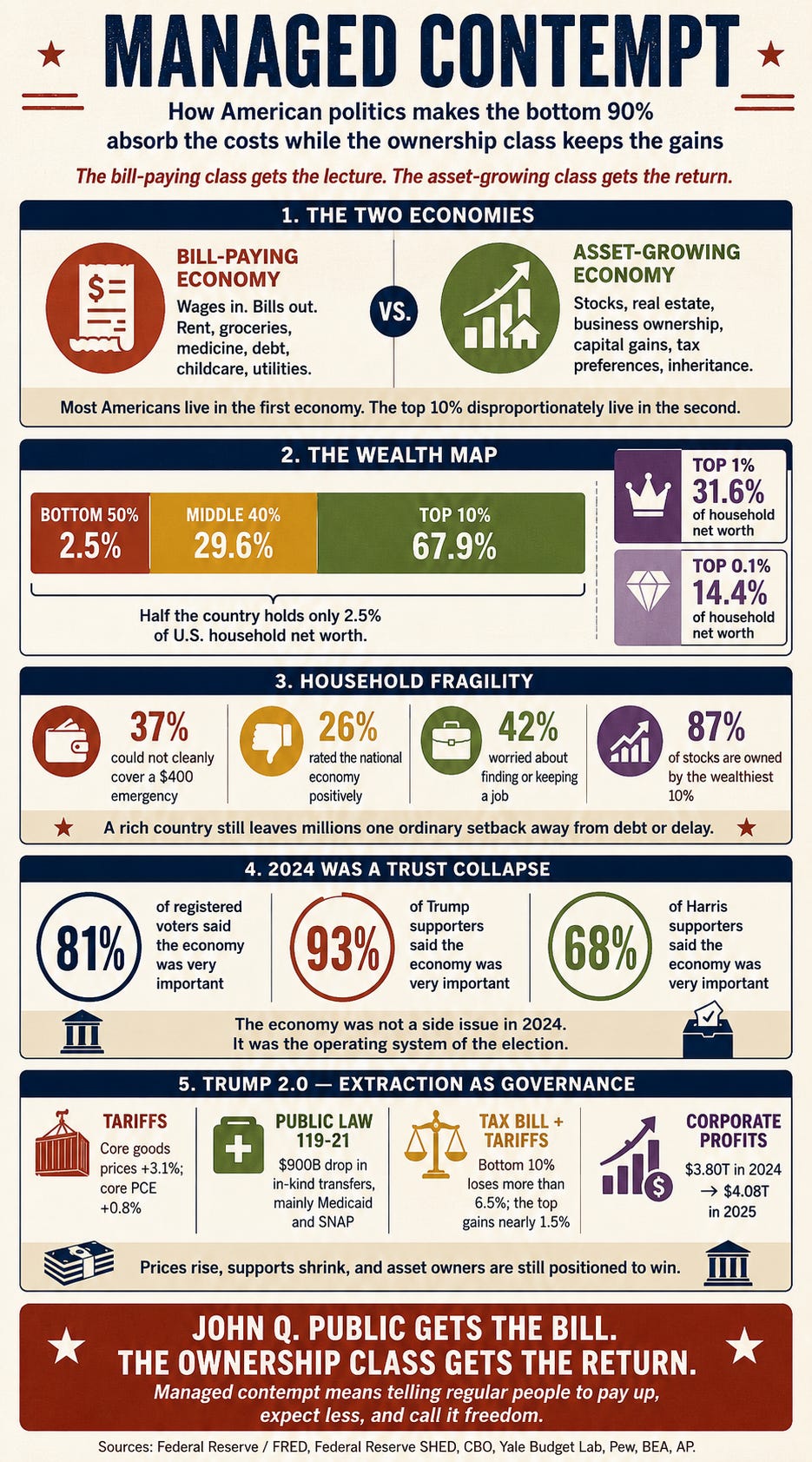
The difference is visible in the wealth map. As of Q1 2026, the bottom half of Americans held only 2.5% of U.S. household net worth. The middle 40% held 29.6%. The top 10% held roughly 67.9%. The top 1% alone held 31.6%, and the top 0.1% held 14.4%.
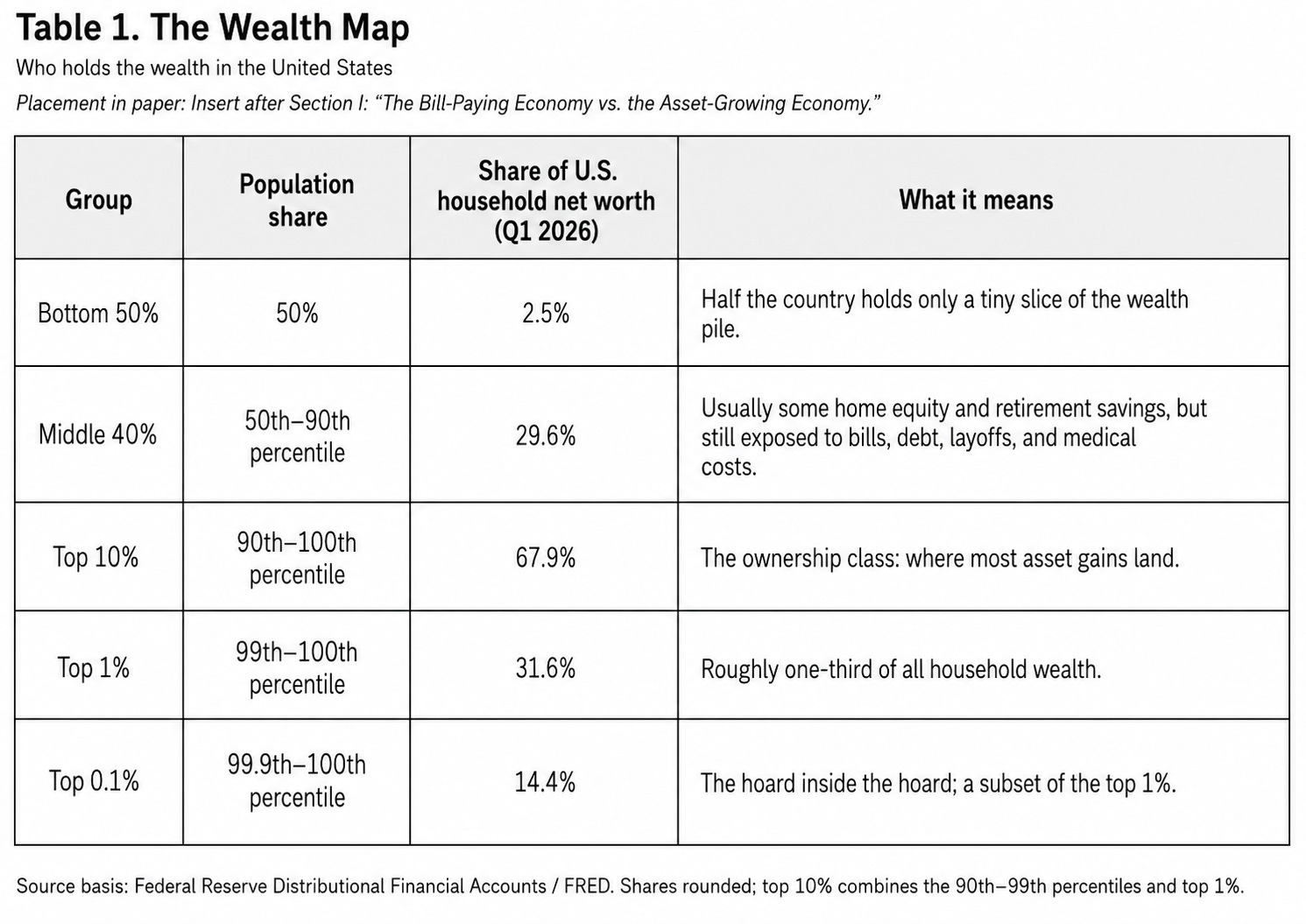
This table is the skeleton of the whole paper. The bottom 50% is not merely “behind.” It has almost no claim on the national wealth pile. The middle 40% may have some home equity, retirement savings, or modest assets, but remains deeply exposed to job loss, medical shocks, debt, childcare costs, and housing instability. The top 10% is where most asset gains land. The top 1% and top 0.1% are the hoard inside the hoard.
This matters because politicians routinely describe economic success using indicators that mainly benefit the asset-owning class. A rising stock market sounds like national prosperity. But if the top 10% owns most stock-market wealth, then stock gains are not evenly experienced. Corporate profits can rise while household life becomes more brittle. Home prices can rise while renters and first-time buyers are locked out. High interest rates can reward cash-rich households while punishing borrowers. Tariffs can be described as toughness while showing up as higher prices.
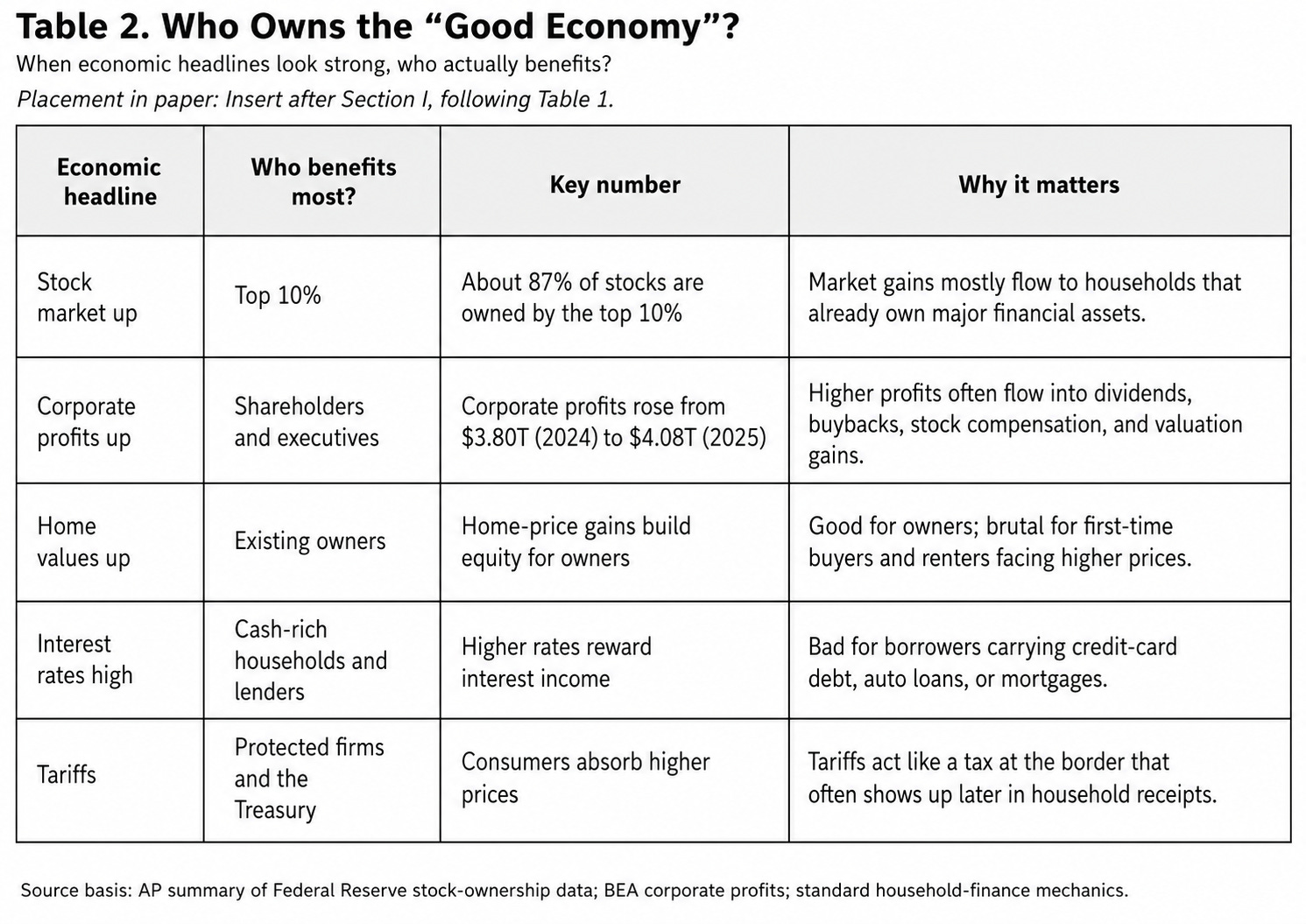
A strong economy for assets can coexist with a weak economy for households. That is the core contradiction. American politics has become very good at celebrating the asset economy and very bad at stabilizing the bill-paying economy.
When public officials say “the economy is strong,” the first question should be: strong for whom?
II. Household Fragility Is Not a Personal Failure
The American safety net exists, but it is not built to catch people before they fall. Too often, it forces people to prove they are already falling.
Social Security, Medicare, Medicaid, SNAP, unemployment insurance, disability supports, public schools, housing assistance, tax credits, and local services all matter. These programs keep millions of people alive, housed and fed. But the safety net is fragmented, means-tested, stigmatized, administratively difficult, and politically vulnerable. For many households, one bad month can become a long-term financial injury.
A true safety net catches people before crisis becomes ruin. The American safety net often arrives after the household has already been damaged.
The Federal Reserve’s household well-being survey showed the fragility clearly: 63% of adults said they could cover a $400 emergency expense with cash or equivalent, which means 37% could not cleanly do so. Only 26% rated the national economy positively, and 42% were worried about finding or keeping a job.
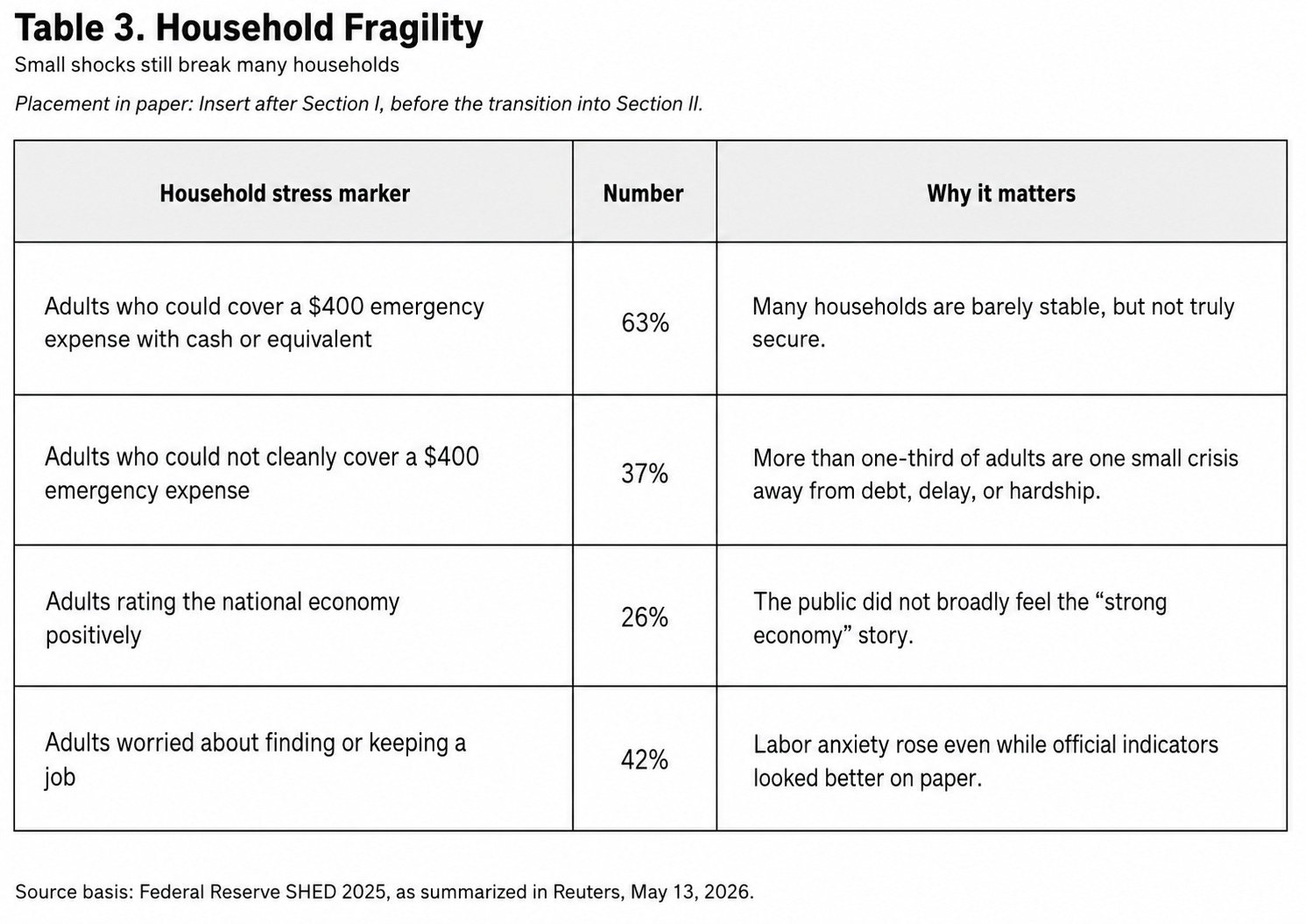
That is the lived economy. Not GDP. Not the Dow. Not a campaign ad. Not a press release. The lived economy is whether the tire blowout, dental bill, rent hike, prescription refill, utility spike, insurance increase, or missed shift breaks the household.
When more than one-third of adults cannot cleanly handle a $400 emergency, the problem is not individual budgeting. The problem is structural brittleness. The country is rich, but millions of households live without enough margin to withstand ordinary life.
This is why “personal responsibility” rhetoric becomes insulting. Personal responsibility cannot repair a healthcare system built around financial exposure. It cannot fix wages that lag costs. It cannot make rent affordable. It cannot turn a delayed benefit into groceries. It cannot convert a theoretical workplace right into power if enforcement is weak. It cannot make the stock market meaningful to households that own almost none of it.
The bottom 50% has 2.5% of the wealth and 100% of the lecture about personal responsibility.
III. 2024 Was Not a Mystery. It Was a Trust Collapse.
The 2024 election was not only about Trump. It was also about the public’s collapsing trust in institutions that kept insisting everything was more stable than it felt.
Voters were not confused because they failed to understand macroeconomic charts. Many understood their own lives perfectly. They knew what groceries cost. They knew rent was higher. They knew insurance was worse. They knew healthcare remained a financial trap. They knew childcare could swallow a paycheck. They knew debt had become a household management tool. They knew the “strong economy” did not feel strong at the kitchen table.
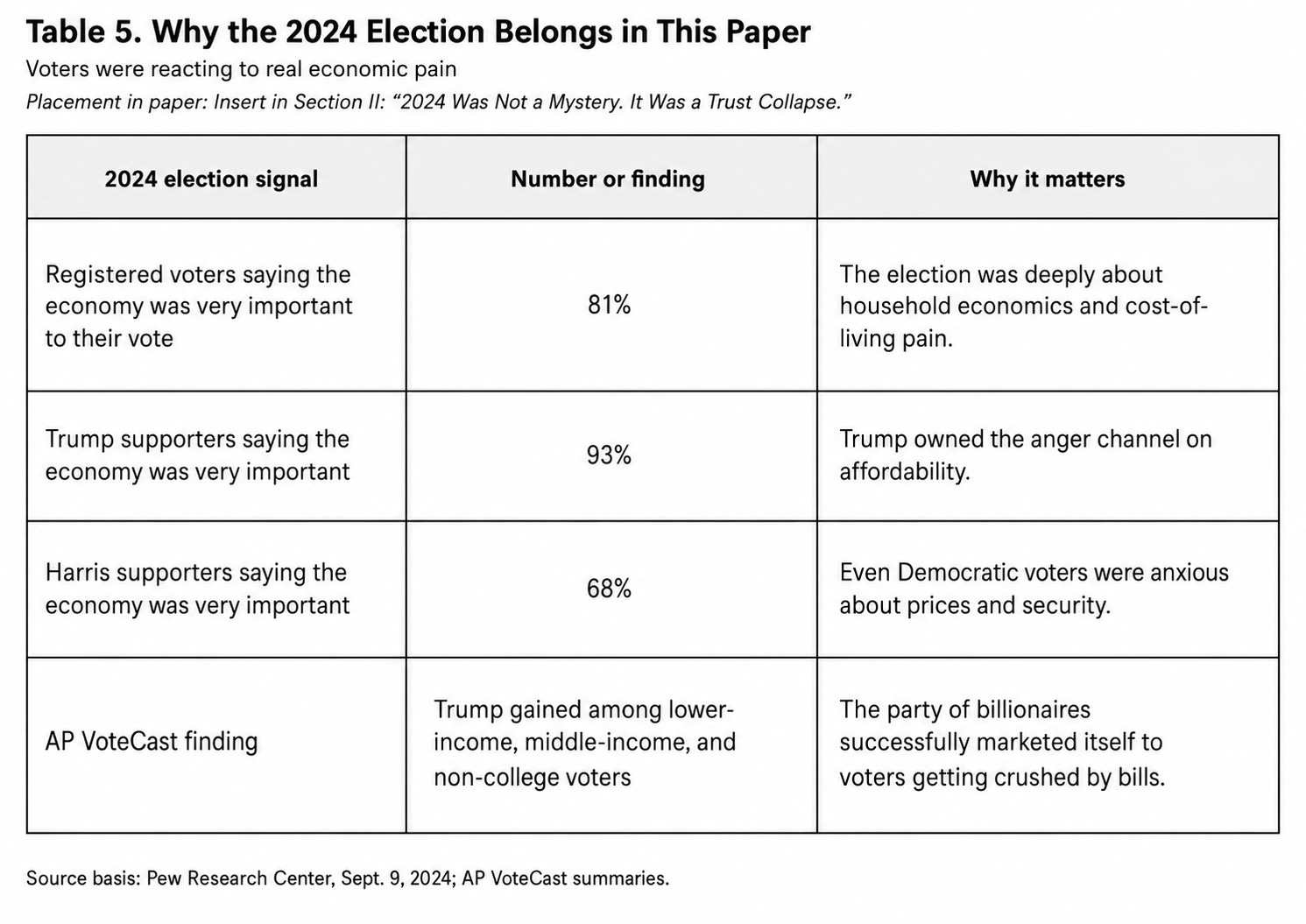
The economy was not a side issue in 2024. It was the operating system of the election. Voters were reacting to household pain, and Trump owned the anger channel on affordability.
The Democratic Party’s failure was not simply messaging. It was credibility.
Joe Biden had been widely understood by many voters as a bridge figure: a stabilizer after Trump, a transitional leader, a return to competence, and a handoff to the next generation. But the party did not run a serious succession process. It did not fully pressure-test its bench. It did not level with the public about age, capacity, voter anxiety, Gaza, affordability, or institutional distrust. When Biden exited the race, the replacement process looked emergency-managed, not democratically renewed.
That mattered. Not because the alternative was harmless. It mattered because authoritarian politics feeds on distrust. When democratic institutions behave like private clubs, they strengthen the cynicism they claim to oppose.
Trump exploited that vacuum. He told economically anxious voters that elites were lying to them. In many cases, voters were right to feel lied to. The tragedy is that Trump did not offer material liberation from the system. He offered a more openly predatory version of it.
The 2024 election should therefore be understood as a class warning. The party of billionaires successfully marketed itself to voters getting crushed by bills. The party that claimed to defend democracy often failed to make democracy feel materially relevant to ordinary life.
That is managed contempt in electoral form: ask the public to save democracy while refusing to trust the public with the truth.
IV. Trump’s Second Term: Extraction as Governance
Trump’s second presidency did not create the two-economy system. It accelerated it.
Tariffs are the clearest example. They were sold as a way to make foreign countries pay. But tariffs function like taxes on imported goods and components. The costs often move through supply chains and show up in consumer prices. Federal Reserve research estimated that 2025 tariffs raised core goods prices by 3.1% through February 2026 and boosted overall core inflation by 0.8%, with tariff pass-through effectively complete.
For the bottom 50%, that means direct price pain. For the middle 40%, it means higher costs plus more debt pressure. For the top 10%, it is more absorbable. Some firms can pass costs forward. Some investors can even benefit from protected industries, pricing power, or market consolidation.
DOGE followed a similar class pattern. It was sold as efficiency. But when “efficiency” means fewer public workers, weaker administration, delayed services, less oversight, broken access points, and reduced enforcement, the burden lands on people who depend on public systems. Wealthy households can buy private substitutes. Regular people wait on hold.
Budget policy continued the shift. CBO’s distributional analysis of Public Law 119-21 (the big booty bill) estimated that federal taxes and cash transfers would increase household resources by $3.3 trillion on net, but federal and state in-kind transfers would decrease household resources by $900 billion, primarily because Medicaid and SNAP benefits would be lower. That is not neutral fiscal housekeeping. That is a movement of risk from the public ledger to the kitchen table.
Yale Budget Lab’s combined analysis of the tax bill and tariffs sharpened the point: the bottom 80% would lose on average, the bottom 10% would see income reduced by more than 6.5%, and households at the top would gain nearly 1.5%.
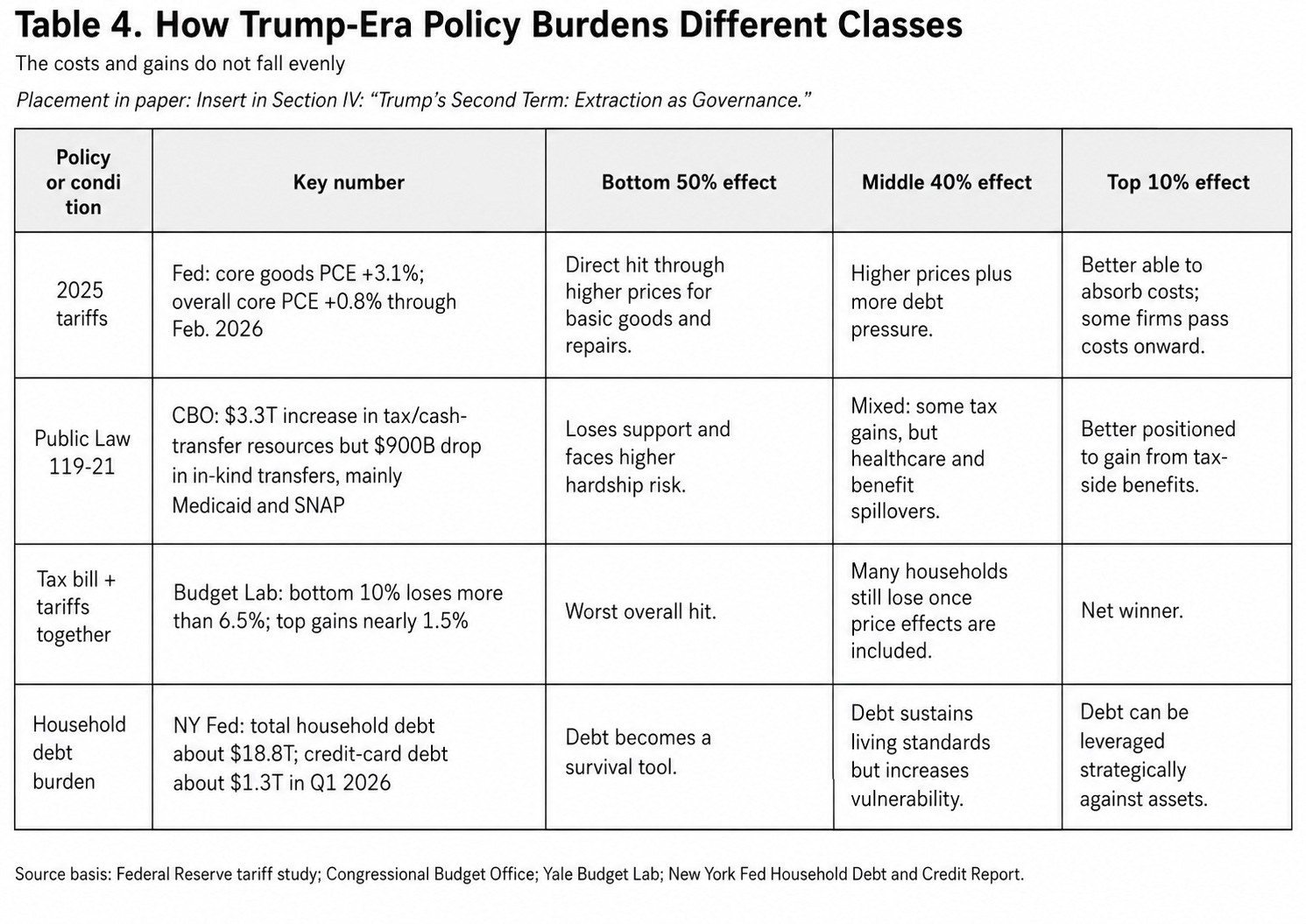
The policy logic is consistent: shift risk downward, shift reward upward, and call the result freedom.
If prices rise, households absorb it.
If benefits shrink, households absorb it.
If public offices are understaffed, households absorb it.
If labor enforcement weakens, workers absorb it.
If tax enforcement weakens, the revenue gap becomes everyone else’s problem.
If corporate profits rise, shareholders benefit.
If markets rise, asset owners benefit.
That is extraction as governance.
It is not “populism.” It is not “draining the swamp.” It is not “America First” for the household that still has to pay the bill. It is a policy structure that turns ordinary people into shock absorbers while asset owners remain positioned to collect the upside.
John Q. Public gets the receipt. The ownership class gets the return.
V. Congress Is Not Minding the Money
Congress is supposed to control the purse. In theory, no money leaves the Treasury unless Congress authorizes it. In practice, Congress often behaves less like a fiduciary for the public and more like a permissions office for executive priorities, donor needs, and contractor pipelines.
The public-finance double standard is everywhere.
If a poor family needs food assistance, the system wants proof.
If an unemployed worker needs benefits, the system wants proof.
If a disabled person needs support, the system wants proof.
If a student needs aid, the system wants proof.
If a contractor wants money, it hires a lobbyist.
If a weapons system needs funding, the question becomes strategy.
If a tax preference benefits wealthy households, it becomes economic policy.
If public money flows upward, the scrutiny softens.
This is how tax dollars become detached from public need. Congress debates whether ordinary people deserve help while routinely allowing vast public resources to flow into defense, border enforcement, corporate subsidies, tax preferences, emergency authorities, foreign-policy commitments, and politically protected industries.
The problem is not that government spends. Government always spends. The question is who the spending protects, who profits, who is audited, who is trusted, who waits, and who pays when the money is mismanaged.
When domestic programs are treated as waste and elite priorities are treated as necessity, the public is not being represented. It is being billed.
Managed contempt is not only policy cruelty. It is fiscal condescension. It tells regular people there is no money, then finds the money for everything above them.
VI. The Hoard Is Political
The original “hoarders hoarded” argument matters because extreme wealth is not passive. It does not simply sit there.
The hoard funds campaigns.
It hires lobbyists.
It shapes think tanks.
It buys media.
It endows institutes.
It influences universities.
It backs litigation.
It captures regulators.
It funds super PACs.
It buys land, water, data centers, housing, patents, platforms, and political patience.
Most importantly, the hoard buys delay.
Regular people live on deadlines: rent due, bills due, premiums due, forms due, appeals due, court dates, school forms, payment plans, medical appointments, tax filings, and shutoff notices. Wealthy actors live through extensions: appeals, restructuring, trusts, foundations, shell entities, lawyers, accountants, donor networks, and regulatory ambiguity.
Delay is a class privilege.
That is why ordinary people often experience government as punishment while elites experience government as negotiation. A working person misses a deadline and loses benefits. A corporation misses a target and renegotiates. A household gets a late fee. A billionaire gets a restructuring plan. A poor person is means-tested. A wealthy person is tax-planned.
This is not accidental. It is architecture.
The hoard does not just accumulate money. It accumulates options. Ordinary people are left with obligations.
VII. The Parties and the Managed Audience
This paper is not a false equivalence. The parties are not identical.
Republicans have more openly used policy to shift wealth upward: tax cuts, deregulation, labor weakening, benefit cuts, privatization, tariffs, contractor politics, and attacks on public administration. Trump’s second term intensifies this project by combining elite economic policy with populist theater.
Democrats have defended many public programs, passed meaningful relief, and remain more open to using government to support ordinary people. But the party has too often managed decline rather than rebuilding the floor. It has too often relied on consultants, donor logic, institutional caution, and messaging discipline instead of a plain economic story rooted in daily life.
That is the bipartisan underservice: one side breaks the floor, the other patches it, and regular citizens keep falling through.
The public is treated as a managed audience. Campaigns study voters, segment them, message to them, trigger them, and fundraise off them. They know voters are anxious about prices, housing, healthcare, debt, work, immigration, war, crime, loneliness, and status. They know people feel talked down to. They know the economy on television does not match the economy at checkout.
Then after every election, the public is treated as if it failed to understand the assignment.
That is backwards. The public understands plenty. It understands that America is rich but ordinary life is insecure. It understands that money can be found for ads, wars, consultants, contractors, tax preferences, emergency political needs, and elite priorities. It understands that household stability remains negotiable.
The insult is not only that politicians lie. The insult is that they often lie badly, then blame the public for noticing.
VIII. Not Stupid. Billed.
The bottom 90% are not stupid. They are not confused because they failed to read the correct report, watch the correct cable segment, or decode the correct economic chart.
They are responding to a real contradiction: America has enormous wealth, but ordinary life is financially fragile. Government can move money, but not reliably toward them. Campaigns can find them, but not always serve them. Politicians can speak their pain, but not always reduce it.
The bottom 50% has almost no wealth cushion. The middle 40% is still exposed to bills, debt, layoffs, and medical shocks. The top 10% owns most of the asset economy. The top 1% and 0.1% own the hoard.
Trump did not invent this structure. He accelerated it. His second-term policies show the pattern clearly: tariffs become household price hikes, DOGE becomes weakened public capacity, benefit cuts become private hardship, labor rollback becomes employer leverage, and tax and market gains become wealth expansion for people already positioned to benefit.
The deeper indictment is not simply that the rich are rich. It is that the political system increasingly protects the mechanisms by which wealth keeps extracting from everyone else.
Regular people pay through prices.
They pay through taxes.
They pay through debt.
They pay through medical risk.
They pay through housing scarcity.
They pay through underfunded public goods.
They pay through political manipulation.
They pay through being told the system is working when their lives say it is not.
That is managed contempt: the politics of telling John Q. Public to pay up, shut up, and call it freedom.
The question is not whether America has enough wealth.
The question is why so much of that wealth depends on ordinary people staying insecure.
Conclusion: Managed Contempt Is a Governing Choice
The evidence in this paper points to a simple but uncomfortable conclusion: the insecurity experienced by ordinary Americans is not an accident of the market. It is the predictable result of a political economy that protects asset owners more reliably than it protects households.
The United States has enough wealth. That is not the question. The question is why so much of that wealth is concentrated in the hands of people least exposed to ordinary risk, while the bottom half of the country holds only a tiny share of household net worth and is still lectured about personal responsibility. The question is why rising corporate profits, stock-market gains, and asset appreciation are treated as proof of national strength while millions of households remain one emergency away from debt, delay, or crisis.
This is the central divide: most Americans live in the bill-paying economy, while the ownership class lives in the asset-growing economy. For the bill-paying class, policy shows up as rent, groceries, insurance, medical bills, debt, childcare, utilities, repairs, taxes, and waiting on hold for underfunded public services. For the asset-growing class, policy shows up as market gains, equity growth, tax advantages, pricing power, capital gains, inheritance protection, and professional management of risk.
The 2024 election did not create this divide. It exposed it. Voters were responding to real economic pain, institutional distrust, and the gap between official optimism and lived experience. Trump exploited that distrust by promising relief from a broken system. But his second-term policies have largely intensified the same structure: tariffs that raise consumer prices, DOGE-driven reductions in public capacity, budget choices that reduce support for vulnerable households, weakened labor power, and tax and market conditions that leave asset owners positioned to gain.
Democrats are not absolved by Republican cruelty. The parties are not the same, but both operate within a system that too often treats regular citizens as a managed audience rather than a governing priority. Republicans have made upward redistribution more explicit and punitive. Democrats have defended important programs but too often failed to rebuild the floor under ordinary life or speak plainly enough about class, power, and money. The result is bipartisan underservice: one side breaks the floor, the other patches it, and regular people keep falling through.
Managed contempt is not simply meanness. It is a structure. It is what happens when public money is scrutinized hardest when it helps the poor and monitored least when it flows upward. It is what happens when households are means-tested, workers are discipline-tested, and families are paperwork-tested, while corporations, contractors, donors, and asset owners are negotiated with. It is what happens when the public is told there is no money for stability, then watches money appear for tax preferences, defense priorities, consultants, campaigns, subsidies, and elite rescue.
The hoard is political. Extreme wealth does not merely accumulate; it organizes. It buys access, delay, legal protection, lobbying power, narrative control, and influence over the rules themselves. It allows its owners to experience government as a negotiation while ordinary people experience government as a deadline.
That is why the phrase “managed contempt” matters. It describes a system that does not need to openly hate John Q. Public in order to harm him. It only needs to keep asking him to absorb the costs, accept the excuses, blame himself, and call it freedom.
The bottom 90% are not stupid. They are not confused. They are responding to the reality in front of them: America is rich, but ordinary life is fragile. Government can move money, but not reliably toward them. Campaigns can find them, but not always serve them. Politicians can speak their pain, but not always reduce it.
A functioning democracy cannot survive forever on this bargain. If the public is expected to work, pay taxes, vote, serve, sacrifice, and trust institutions, then those institutions must materially serve the public. Household stability cannot remain a private problem while asset growth remains a public priority.
The question is not whether America has enough wealth.
The question is why so much of that wealth depends on ordinary people staying insecure.
John Q. Public gets the bill. The ownership class gets the return. That is not an economy. That is managed contempt
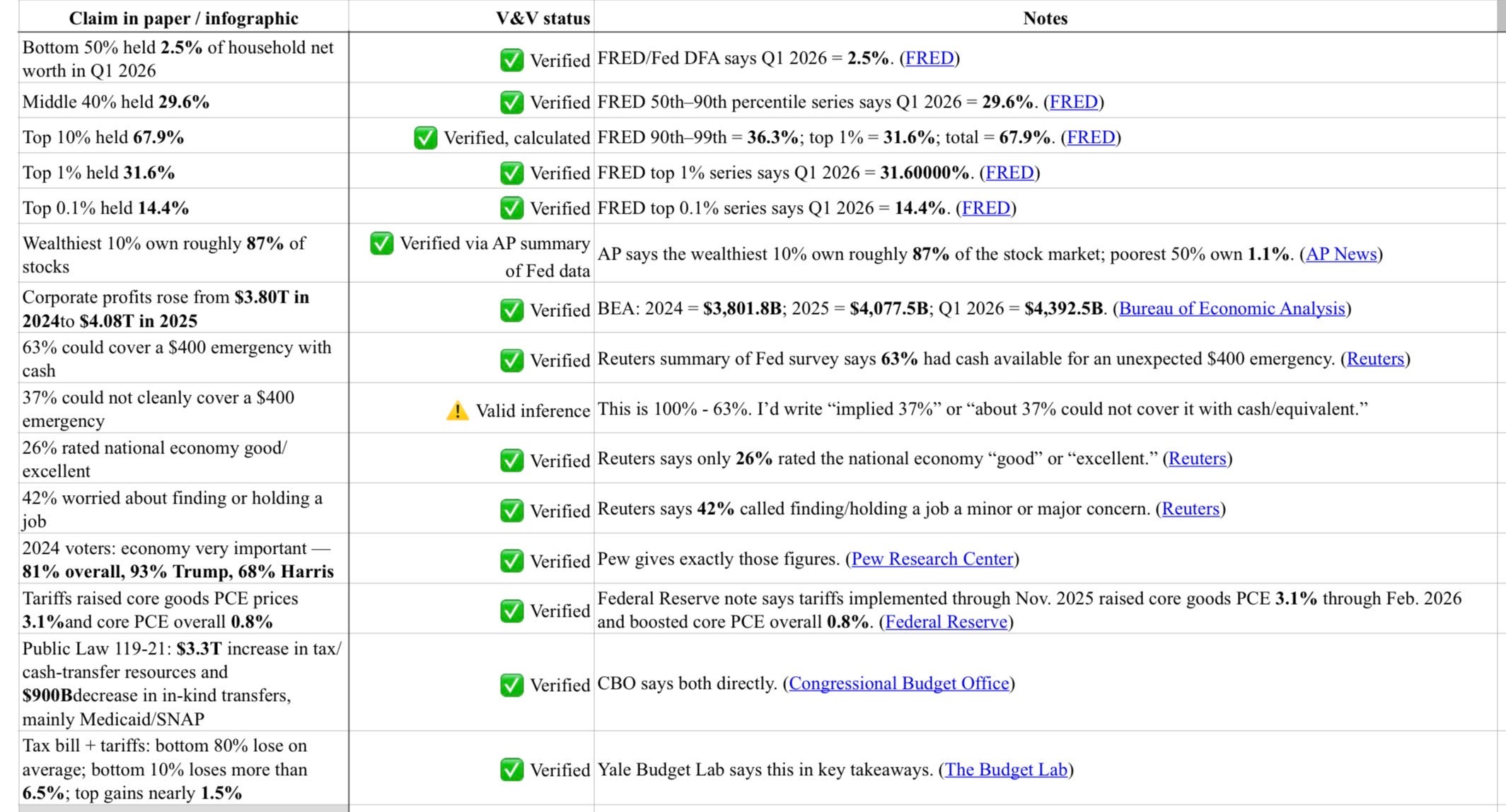
Data verified, apologies for any weird table labeling.
There is nothing left.
Soon we will…